The car dashboard has undergone a digital facelift in recent years, with sleek touchscreens, subscription-based apps and advanced smartphone integration. But as Automotive Original Equipment Manufacturers (OEMs) decide which features to keep and which to cut in the name of visual appeal, is audio appeal being sacrificed? In other words, is traditional AM/FM radio still a necessity?
A comprehensive In Car Radio Study conducted by Nielsen in partnership with iHeart in May 2026 reveals a resounding answer: Radio is not only necessary, it is one of the most valuable entertainment options in the car. Stripping AM/FM radio from vehicles isn’t just an unpopular design choice but a direct threat to customer loyalty and, ultimately, vehicle sales.
The National Association of Broadcasters echoes that sentiment and bipartisan lawmakers, at the urging of hundreds of thousands of Americans, are pressing for legislation to require AM broadcast radio as standard equipment in all new motor vehicles.
But our data illustrates the consumer resolve, across all demos.
The Undeniable Demand: A “Must-Have” Feature
Despite the influx of modern infotainment options, the study of over 1,000 recent and prospective car buyers highlights that traditional radio remains bedrock equipment.
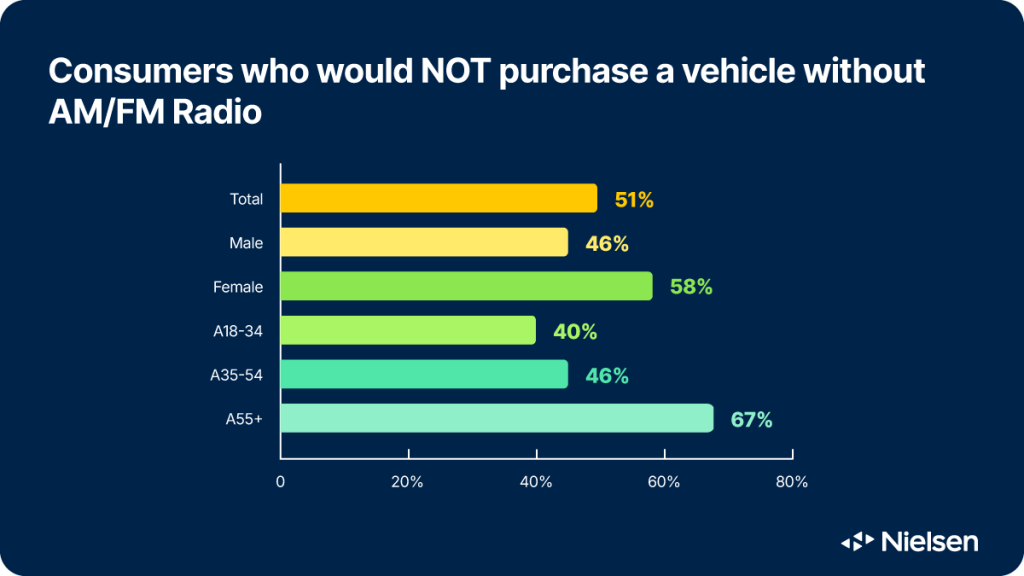
- The Dealbreaker: Around half of all respondents stated they would outright refuse to purchase a vehicle that lacks an AM/FM radio.
- Basic Equipment Expectation: Over 7 in 10 consumers view AM/FM radio as an essential feature that should come standard as basic equipment in all new vehicles. This places its perceived importance on par with smartphone integration (Apple CarPlay/Android Auto) and significantly ahead of satellite radio or built-in subscription music apps.
- Dominating Airtime: When it comes to actual behavior, consumers vote with their dials. According to Edison’s Q1 2026 Share of Ear study, radio accounts for 55% of all audio time spent in the car. Streaming accounts for 16% and YouTube, podcasts, SXM and owned music / audio books make up the remaining 29%.
The Economic Value of Radio
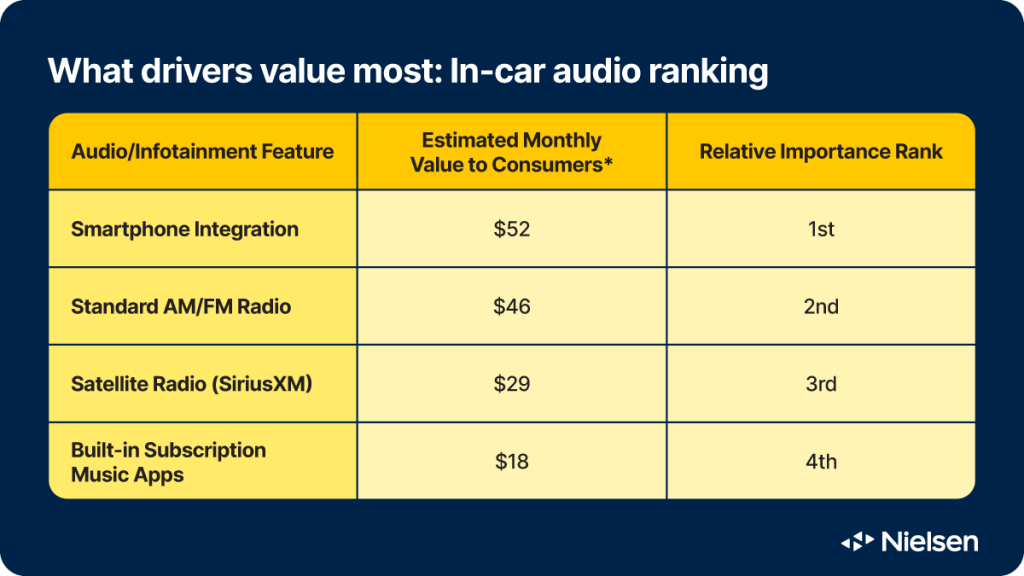
To dig past surface-level preferences, Nielsen utilized a Choice-Based Conjoint (CBC) Analysis. This research also included a Choice-Based Conjoint (CBC) analysis—a methodology widely used in the automotive sector because it mirrors real-world shopping decisions by forcing consumers to make tradeoffs among features and price. This analysis supported the findings from the more direct survey questions and shows the considerable weight consumers continue to give to the presence of AM/FM radio in their vehicle purchasing decisions. The ranker below lists audio/infotainment features by their impact on respondents’ vehicle choice decisions and shows that AM/FM radio had the second highest impact, just behind smartphone integration.
The Threat to Brand Equity
For automakers, the risk of removing AM/FM radio goes beyond the dashboard to the dealership lot. It can affect how consumers feel about the brand itself.
- Brand Backlash: Around half of respondents indicated that if an OEM decided to completely remove AM/FM radio from its lineup, they would instantly have a less favorable perception of that car brand.
- The Age Factor: This brand erosion and purchase refusal is significantly more pronounced among buyers aged 55+, creating a massive hurdle for brands relying on loyal, returning buyers.
More Than Just Music: Safety, Sports, and Connection
What might explain the continued loyalty to AM/FM radio? Many drivers value the practical benefits that streaming apps struggle to replicate as smoothly.
- Safety First: 8 in 10 respondents say it is important for their vehicle to receive national Emergency Alert System notifications, one of broadcast radio’s defining strengths. Interestingly, this safety element is highly valued by younger demographics (ages 18–54).
- Zero Latency for Live Sports: Live sports scores as a differentiator with 2 in 3 consumers noting that “zero latency” (the broadcast not lagging behind real-time action) is important when listening to sporting events in the car. This feature of AM/FM is especially valued by male drivers, younger demographics, and Hybrid/EV owners.
- Hassle-Free Local Connection: More than 3 in 4 buyers agree that AM/FM radio is a simple, friction-free entertainment option and a reliable “neutral” choice when traveling with friends and family. 8 in 10 also find it important for accessing real-time traffic and local news updates.
The Balanced Dashboard Blueprint
Drivers are not asking for an “either/or” dashboard; they want a balanced infotainment ecosystem, with connectivity and built-in utility. The study reveals that 4 in 10 drivers prioritize connecting their phone (via Bluetooth or CarPlay/Android Auto) the moment they step into a vehicle, but a quarter of respondents still look to connect to AM/FM radio as their very first action.
For OEMs looking to secure market share and build vehicles that consumers love, the takeaway from Nielsen’s 2026 data is clear: innovation should add to the dashboard, not strip away what drivers already value. Keeping standard AM/FM radio in the vehicle isn’t just about preserving tradition. It may also help preserve brand equity and sales.