Twenty years ago, the first pitch was thrown in a World Baseball Classic game between South Korea and Chinese Taipei in the Tokyo Dome. Over the last two decades, the tournament has emerged as a global showcase of the best in the sport. The energy…the national pride…the passion. Seattle Mariners’ superstar Julio Rodriguez summed it up best when he said winning the WBC for the Dominican Republic would be “No. 1” on his list, even over a World Series. And New York Yankee Aaron Judge noted after this year’s U.S. victory over the Dominican Republic that the World Baseball Classic was bigger and better than the World Series.”
The viewership on FOX, FS1, FS2, and FOX Deportes for the 2026 World Baseball Classic supported that narrative, culminating with 10.78 million viewers (FOX and FOX Deportes ) for the championship game between the US and Venezuela..
It’s not just about scale either. The WBC is attracting a broader, more multicultural audience than ever before, turning it into a cultural touchpoint that extends far beyond traditional baseball markets.
In an era where sports serve as both entertainment and identity, the World Baseball Classic has transitioned from a niche tournament into a global phenomenon characterized by shifting demographics and evolving media habits.
The WBC tells the story of evolving trends among baseball fans that parallel factors fueling a worldwide growth in sports, including rapid audience gains, rising multicultural engagement, and an increasingly connected digital fanbase.
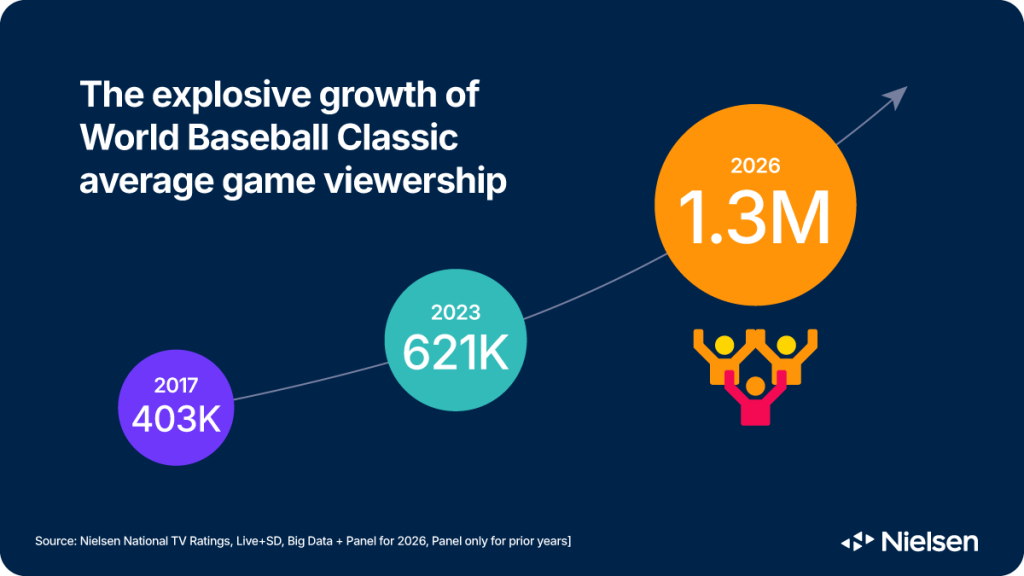
The explosive growth in viewership
The record-setting audience growth for WBC games reflects a rising global interest in baseball and the diversification of the sport’s fanbase.
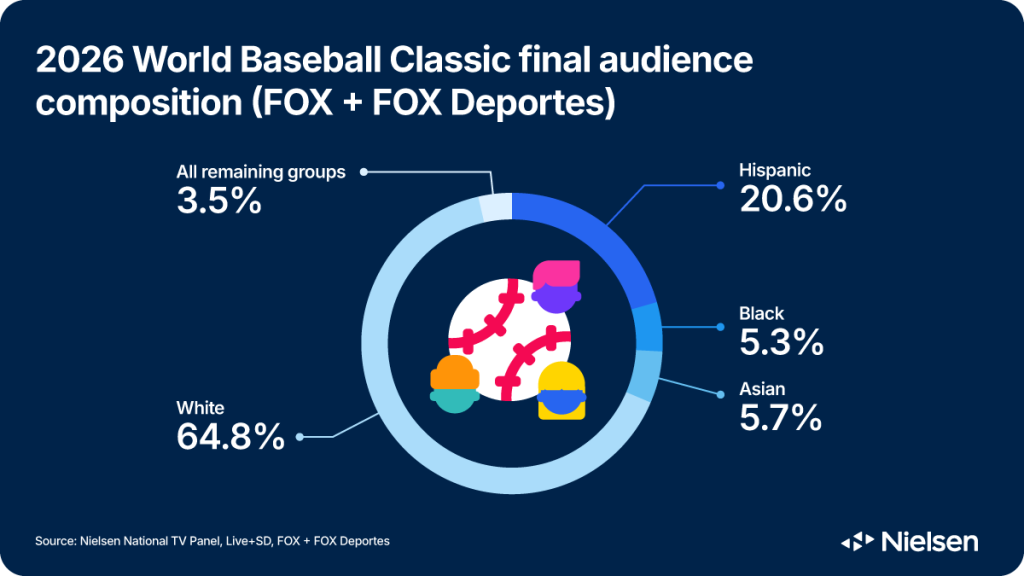
Not only driven by scale but also by who is watching, the WBC has attracted a broader, more multicultural audience than ever before. It’s become a cultural touchpoint that extends far beyond traditional baseball markets.
This was in part the result of FOX deftly moving the championship from cable (FS1 in 2023) to the main broadcast network, which increased access and ensured the final would reach a wider audience. However, it should be noted that the US -Dominican Republic semifinal on FS1 and FOX Deportes brought in 7.37 million, with 6.86 million on FS1 alone. And what makes that even more remarkable, is that the game went head-to-head with the Academy Awards, typically one of the most-watched programs of the year. The overall growth has also been seen by Major League Baseball, where the 2025 playoff season notched 58.2 billion viewing minutes, a 24% increase over the previous year.2
As discussed in the second part of our 2026 Upfront Planning Series, the growing interest in baseball is part of a larger powerhouse era for live sports where they accounted for nearly 30% of all ad supported TV viewing in Q4 of 2025.3
A celebration of cultural diversity
What distinguishes the World Baseball Classic is not just how many people are watching, but who those viewers are.The audience composition figures above accentuate the tournament’s ability to draw a broader and more representative audience than many traditional sports broadcasts. The long-term trends are even more compelling. Hispanic viewership of the WBC final increased by 61.5%, Asian viewership rose nearly 80%, and Black viewership showed a 63.5% gain.4
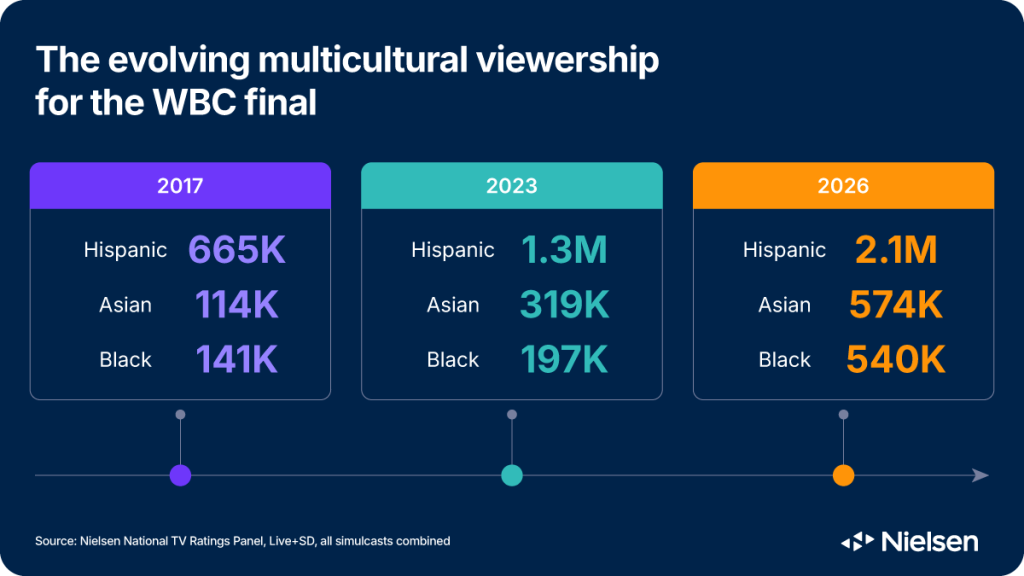
These increases mirror broader MLB trends where Asian American viewership of the 2024 World Series rose 146% year-over-year and 2025 international season opener viewership was up 111% among Black viewers and more than 200% among Hispanic viewers.5
The WBC does not just reflect diversity—it accelerates it, turning representation into a central feature of the viewing experience. Fox Deportes understood this, tapping into intense national pride and passionate fan bases to create an atmosphere mirroring the passion of soccer-style international competition.
Commercial power meets cultural relevance
As baseball’s audience becomes more multicultural and engaged, its commercial value continues to rise. Brands are increasingly recognizing the importance of aligning with culturally resonant sports properties like the World Baseball Classic and the MLB.
At the highest level, sponsorship assets tied to baseball generate significant returns. In 2025, deals such as Guggenheim Partners’ Los Angeles Dodgers jersey sleeve ($80.3 million in media value), Security Benefit’s home plate signage ($44.1 million in media value), and Starr Insurance’s New York Yankees jersey sleeve ($38.3 million in media value) ranked among the most valuable in sports.6
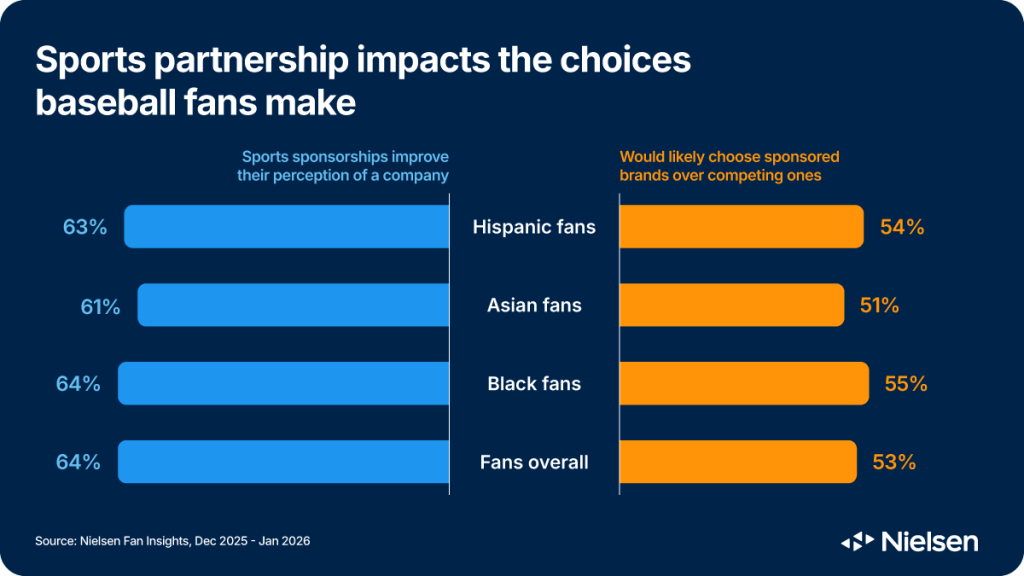
On an individual level, fans respond through support and purchases when they feel represented, showing the tangible impact sports partnerships have on consumer behavior.
Cultural collaborations are also driving huge returns. A co-branded collaboration between artist Takashi Murakami and MLB for the 2025 Tokyo Series delivered over $40 million in sales and sold out almost instantly.7
Digital communities and year-round engagement
The growth of the World Baseball Classic has been amplified by how fans engage with the sport beyond traditional broadcasts.
According to a Forbes article, social media posts during the WBC tournament from MLB, MLB Español, and the World Baseball Classic accounts generated more than 2.24 billion global views across platforms through the semifinals.8
Today, almost 75% of U.S. baseball fans use social media to stay informed about sports, turning platforms into real-time hubs for highlights, commentary, and cultural conversation.9 This always-on engagement is particularly important for reaching younger and more diverse audiences.
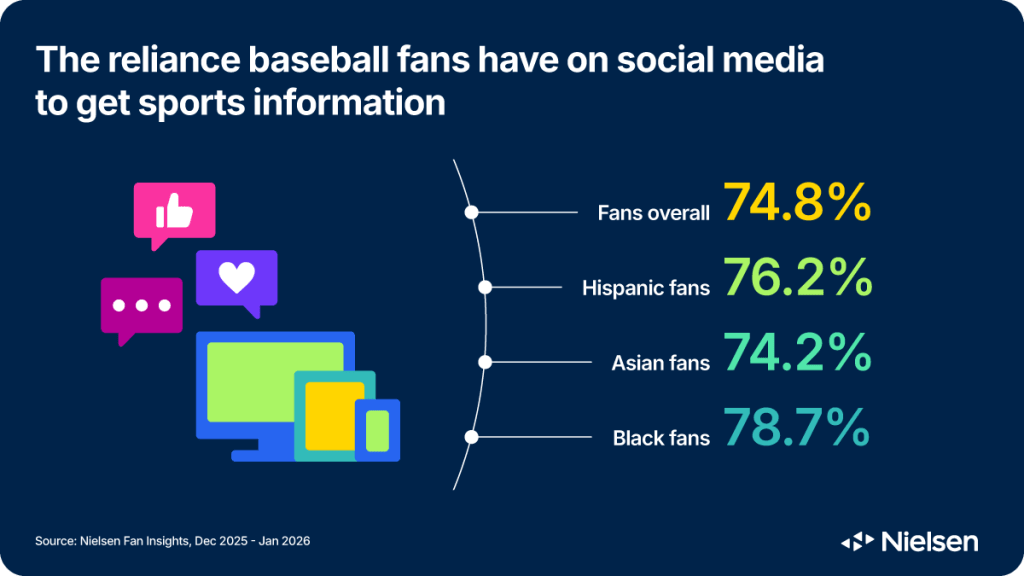
These behaviors show how the WBC exists not just as a broadcast event, but as a multi-platform ecosystem—one that supports deeper and more sustained digital engagement across culturally diverse communities.
Learning the lessons from the WBC
As Nielsen media intelligence shows that while the tournament only occurs once every four years, the World Baseball Classic is a microcosm of the trends and opportunities for advertisers and marketers looking to connect with a growingly diverse audience through baseball and sports in general.
What was once a niche international competition is now drawing record-breaking audiences and capturing the attention of a broader audience.
At its core, the WBC tournament is not just about who wins or loses. It is about representation, visibility, and the emotional ties that bind fans to teams that reflect their heritage and identity.
As the tournament grows in scale and significance, it is redefining what baseball means in the 21st century—not just as a sport, but as a cultural force that commands attention.
For more insights into today’s AANHPI fans and how to connect with them, check out our report Breakthrough ROI: Investing in Asian American audiences and media.
For more insights into today’s Black fans and how to connect with them, check out our report The Black influence: How Black culture & identity drive the market.
For more insights into today’s Hispanic fans and how to connect with them, check out our report How Hispanic consumers are influencing the media landscape.
Notes:
1 Nielsen National TV Ratings, Live+SD, Big Data + Panel. Includes simulcasts on FOX Deportes.
2 Nielsen national TV ratings, live+SD, 2025 MLB postseason, panel-only
3 Analysis of 4Q25 (9/29/25 – 12/28/25, Nielsen National TV Panel Data augmented by Streaming Platform Ratings ad supported includes broadcast and independents, ad supported cable, and streaming minus non ad supported streaming Sports Event Summary type and live streaming events excluded from broadcast, cable, and streaming buckets and re-aggregated
4 Nielsen National TV Ratings Panel, Live+SD, all simulcasts combined
5 Nielsen National TV Audience Measurement Big Data + Panel, Persons 2+
6 Nielsen Sport24
7 Sportico
8 Forbes
9 Nielsen Fan Insights, Dec 2025 – Jan 2026