Four years of advertiser investment. Eight tournaments. One global stage. Nielsen Ad Intel explains the seismic shift of soccer fandom in the U.S., revealing who’s watching, who’s winning the ad game and what to expect from FIFA World Cup 2026™.
Soccer may be the world’s most popular sport, but in North America, it’s three very different games. Mexico, Canada, and the United States each arrive at 2026 with their own fanbase, history, viewing habits, and reasons to cheer. And even within each country, loyalty shifts depending on the league, the tournament, and the moment.
Mexico’s soccer identity runs through Liga MX, the most-watched soccer league on U.S. television in 2025, outpacing UEFA Champions League, the Premier League, NWSL, and LaLiga.1 In Canada, fandom rallies behind the CanWNT and the NWSL, the latter of which is U.S. based but built heavily on Canadian talent. And in the United States, soccer has passed from emerging interest to cultural infrastructure, anchored by a fanbase over 62 million-strong that ranks fifth in the world.2
Advertisers, who have invested nearly $1.8 billion in in-program national TV advertising across eight tournaments in the past four years, have learned that fandom looks different by league.3 Nielsen Ad Intel data on the airings of the 2022 Men’s World Cup in Qatar, through the FIFA Club World Cup™ 2025 hosted in the U.S., shows advertising spend and, more importantly, category presence, illuminating brand strategy ahead of FIFA World Cup™ 2026.
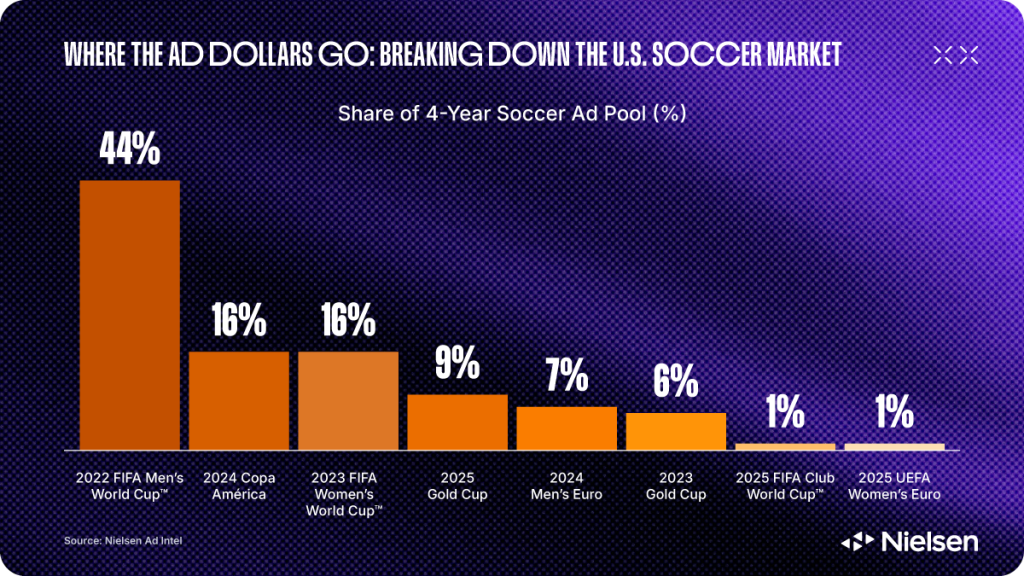
In this analysis, the FIFA Men’s World Cup™ 2022 dominates the investment, commanding a massive 44% share. But when we look past that peak, a more interesting pattern emerges. Today, tournaments deeply tied to Mexican and Latin American fandom like The Gold Cup, Copa América, and FIFA Club World Cup™ all pull in advertiser backing at scale in the U.S. every time they air. The 2024 Copa América, hosted in the U.S., captured 16% of that multi-year total, matching the scale of the 2023 FIFA Women’s World Cup™ and dwarfing the 2024 UEFA Euro by more than 2x. The Gold Cup’s advertising presence grew 51% from 2023 to 2025, climbing from a 6% share to over 9%, even though the tournament itself doesn’t draw a single non-CONCACAF nation.4
Fans whose hearts are with Mexican and Latin American soccer
The most consistent signal in the data is that across the tournaments with the deepest Mexican and Latin American audience ties (The Gold Cup, Copa América, FIFA Club World Cup™), the same families of advertisers have had a steady presence: beer and spirits, quick-service restaurants, wireless and telecom, auto and credit and money-movement services.5 These are anchor investors who make these tournaments fixed annual obligations, understanding this audience isn’t a trend to chase but a relationship to maintain.
The reason is logical: Wireless carriers, QSR chains, financial services, and remittance brands have some of the deepest, longest-running relationships with U.S. Hispanic consumers of any category in advertising. Latinos are a must-have audience that is loyal to brands who advertise in their favorite sports, so when the tournament reaches that audience, brands show up, and the fans follow through. Nielsen Fan Insights proves this, with 50% of Hispanic soccer fans saying they feel more loyal to companies that sponsor the sports they follow, compared to only 38% of the general population.6
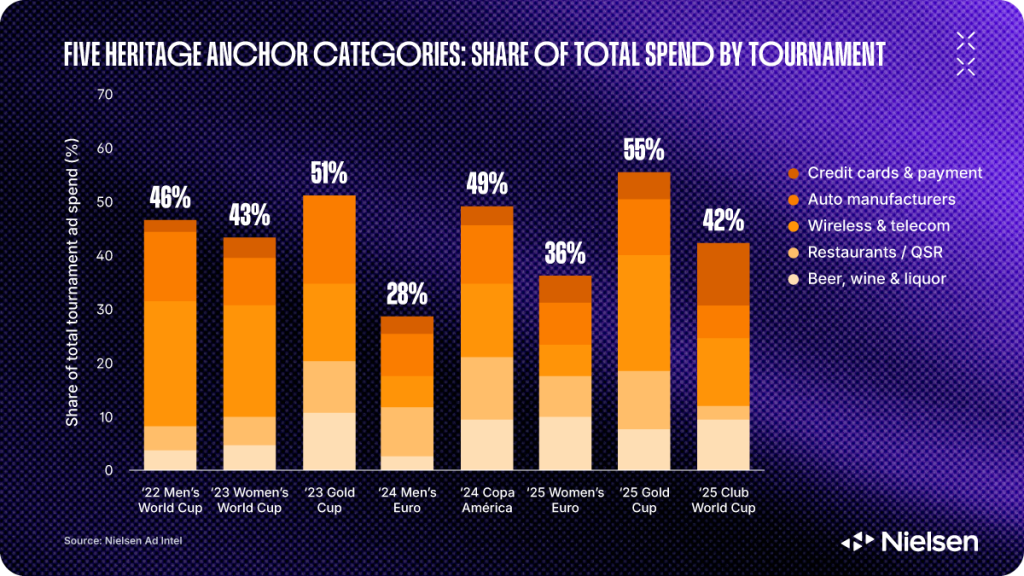
Five heritage-anchor categories alone made up 55% of all ad spend on the 2025 Gold Cup, 51% on the 2023 Gold Cup, and 49% on the 2024 Copa América. In the 2024 UEFA Euro, a tournament with a smaller, more English-dominant U.S. audience, those same categories were just 29%.7 When it comes to Hispanic audiences, the anchor brands stay put; these audiences are the bedrock of U.S. soccer fandom, and the brands that serve those audiences year-round have built durable relationships with them that they fully expect to carry into every other soccer property they sponsor. A fan who shows up for Mexico vs. Panama in the Gold Cup is the same fan who’s going to be watching Argentina, Brazil, and Germany play in 2026, and the advertisers know it.
The category shifts that hint at where 2026 is headed
The Gold Cup serves as an ideal year-over-year benchmark due to its consistent format and audience. While total spend grew 51% from 2023 to 2025, the fastest-climbing categories highlight which sectors find the most value in soccer audiences.8
While heritage-anchor categories like auto and beer/spirits maintained steady investment, overall growth was driven by new entrants stacking on top of that established foundation. Wireless and telecom became the largest category in 2025 after more than doubling its investment, while Pharma and OTC nearly quadrupled. Of note, credit and remittance brands expanded to 98 times their 2023 volume, surging from near-absence to the tournament’s sixth-largest category.9 This reflects first-mover behavior from brands previously unattached to the sport.
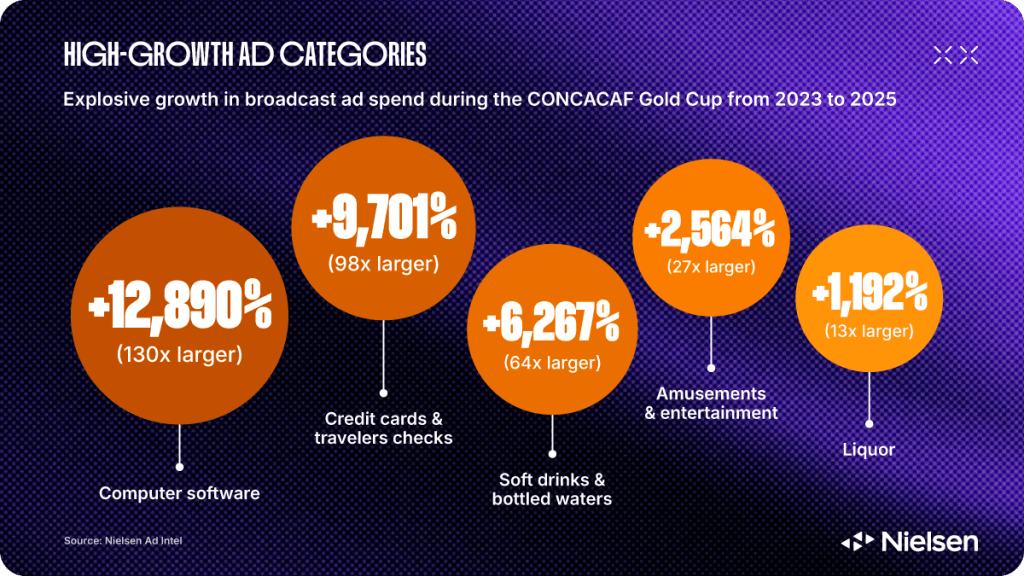
There is a detail in The Gold Cup growth worth pausing on. Between 2023 and 2025, ad spend grew 51%, but the average audience grew about 20%.10 That might look like advertisers paying a premium for limited inventory, but the more accurate read is about the recognition of audience value. The Gold Cup isn’t a tournament brands buy for reach; they buy it because they know the audience is committed to the teams, to the tournament, and to the brands that have earned their place in the narrative. The spend curve is actually signaling how quickly advertisers are recognizing the value of this audience.
Different tournaments, different category signatures
Nielsen data tells us each tournament has a category fingerprint. Euro 2024 was the only property in the eight-tournament set where the Computer Software category cracked 14.6% of total spend. This is a concentration that doesn’t show up anywhere else in the data, and it most likely represents streaming services and tech platforms placing focused bets on that tournament’s audience. Insurance was 13.7%, also unusually high. In the Latin tournaments, those two categories barely register.
The shift is clearly visible when optical goods start showing up. In the 2025 Gold Cup, that, as well as gas, oil and transportation services were among a set of categories that had spent very little on the same tournament in 2023. Individually the dollars are small, but collectively they say something big. These are everyday, place-based categories with no natural tie to soccer. These are the kinds of brands that buy primetime or the Oscars, not a niche sports property. The beer and QSR brands were always there, but when the gas stations and convenience retail brands start showing up, it means soccer has crossed over from a sports buy into a mainstream reach buy.
The most recent tournament kicked off some interesting insights. The 2025 FIFA Club World Cup™ had a noticeably more modern advertiser mix than any other tournament in this dataset. Amusements and events, ready-to-wear apparel, credit cards and payments, and soft drinks all over-indexed sharply, indicating more of a lifestyle buy that is reaching out to young, culturally fluent, experience-minded consumers.13
What Ad Intel data points toward for 2026
The FIFA World Cup 2026™ is unlike anything North America has hosted before. Forty-eight teams, 104 matches, three countries, 11 U.S. host cities: Atlanta, Boston, Dallas, Houston, Kansas City, Los Angeles, Miami, New York/New Jersey, Philadelphia, San Francisco Bay Area, and Seattle. And the audience is ready for it. Nielsen Fan Insights finds that 56% of U.S. soccer fans say the FIFA World Cup™ is the reason their interest is climbing, while 33% of the broader U.S. population expects their interest in soccer will grow through the tournament.14 And that indicates that the sport has outgrown the stadium and moved into the culture. Hispanic audiences will be the most engaged segment, with 81% of first- and second-generation Hispanic fans planning to engage via mobile and social during the tournament.15
If the four-year Ad Intel data tells us anything, it is that the heritage-anchor category advertisers (beer, QSR, wireless, auto, and payments) will show up first, biggest, and with the deepest year-over-year commitments, because they’ve already proven the audience converts. The interesting question is which categories follow. Pharma’s climb across the 2025 tournaments suggests they are building momentum and commitment to the tournaments and audience. Credit and remittance brands moved from absent to present on the Gold Cup in just two years. Tech platforms ran a 14.6% category share on Euro 2024.16 What will they do in a global tournament hosted at home?
The other thing the data clarifies: U.S. soccer fandom can’t be understood through the USMNT alone. Liga MX was the most-watched soccer league on U.S. television in 2025, and the bedrock fan in the U.S. is just as likely to be cheering for Mexico or a Liga MX club as anything else.17 That fan is bringing their fandom with them to every other tournament and the brands that have been showing up for that audience for years are the ones already positioned to win in 2026.m
Want to dive deeper?
Maximize your tournament strategy: Visit Nielsen’s FIFA World Cup™ Media Intelligence Hub to unlock data-driven insights, viewership trends, and key activation strategies ahead of this summer’s historic tournament.
Track the competitive landscape with Ad Intel: Discover how to monitor exactly where your competitors are (and aren’t) showing up with their ad spend, and learn how to unlock the live insights needed to optimize your media strategy leading up to the tournament.
Notes
1 Source: Nielsen National TV Ratings, Live+SD, Big Data + Panel. Includes both English and Spanish language coverage
2 Source: Nielsen Fan Insights, Nov 2025 – April 2026
3Source: Nielsen Ad Intel*
4Source: Nielsen Ad Intel*
5Source: Nielsen Ad Intel*
6Source: Nielsen Fan Insights, USA, March 2026
7Source: Nielsen Ad Intel*
8Source: Nielsen Ad Intel*
9Source: Nielsen Ad Intel*
10Source: Nielsen Ad Intel*; Nielsen National TV Ratings, Live+SD, Big Data + Panel. Includes both English and Spanish language coverage
11Source: Nielsen Ad Intel*
12Source: Nielsen Ad Intel*
13Source: Nielsen Ad Intel*
14Source: Nielsen Fan Insights, Sept 2025 – Feb 2026
15Source: Nielsen Fan Insights, April – June 2025
16Source: Nielsen Ad Intel*
17Source: Nielsen National TV Ratings, Live+SD, Big Data + Panel. Includes both English and Spanish language coverage
*Nielsen Ad Intel data for in-program national TV advertising during the broadcast windows of eight tournaments: FIFA Men’s World Cup™ 2022, FIFA Women’s World Cup™ 2023 , 2023 CONCACAF Gold Cup, 2024 UEFA Men’s Euro, 2024 Copa América, 2025 UEFA Women’s Euro, 2025 CONCACAF Gold Cup, and FIFA Club World Cup™ 2025. Categories reflect Ad Intel Major Category groupings.